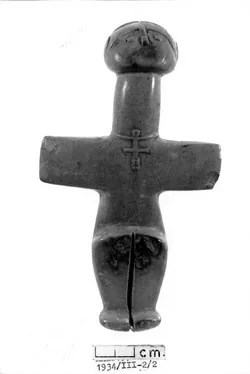
Chalcolithic period · around 3000 BCE
When we first drew up the chronology of our journeys, we mistakenly placed the Pomos Idol in the late Palaeolithic. We later checked the date against archaeological publications: it is a cruciform figurine from the Chalcolithic period, approximately the fourth millennium BCE. We do not hide that mistake, because the process of correcting a date is itself a useful example of how historical research works.
The figurine is carved from picrolite and has the museum inventory number 1934/III-2/2. It is about 15 centimetres high. Its arms extend sideways, the facial features are indicated very simply, and a small cruciform figure is shown on the chest; it may represent a pendant or a child. Similar cruciform figurines are characteristic of Chalcolithic Cyprus.
The Pomos Idol is displayed in the Cyprus Museum in Nicosia. Its image was chosen for Cyprus’s €1 and €2 coins, so an object from deep prehistory has become part of everyday life in modern Cyprus. In the museum’s first gallery we also look at stone vessels and tools from Choirokoitia, early pottery, and schematic figures of people and animals in order to see how materials and images changed from the Neolithic to the Chalcolithic period.
We corrected the dating after checking official archaeological material: the Pomos Idol belongs to the Chalcolithic period, not the Palaeolithic.
Images